If you’d been following my blog at all or even bothered to peruse it a little before dropping this message in my inbox, you’d probably already know the answer to your question.
You’d ALSO probably know that there are bi and pan aspecs too (e.g., I’m panromantic demisexual) which isn’t “gay” (does this term also include lesbians?) so I feel like your ask erases part of my own identity and that of others in the community.
For these reasons and more, I’d bet money that you’re not here because you’re “curious”. You’re probably here because you figure this is how you’re gonna stop a “self-imposing” aspec from speaking up for herself.
When you repeatedly observe such findings it grabs your attention as a prejudice researcher. But let’s go back a minute and consider those discrimination effects. Really? You’d not rent an apartment to an asexual man, or hire an asexual woman? Even if you relied on stereotypes alone, presumably such people would make ideal tenants and employees. We pondered whether this bias actually represents bias against single people, a recently uncovered and very real bias in its own right (see Psychology Today column by Bella DePaulo). But our statistical analyses ruled out this this possibility. So what’s going on here?
If you’ve been following my column, you’ll recall that I wrote a recent article on what I called the “Bigotry Bigot-Tree” – what psychologists refer to as generalized prejudice. Specifically, those disliking one social group (e.g., women) also tend to dislike other social groups (e.g., homosexuals; Asians). In our recent paper (MacInnis & Hodson, in press), we found that those who disliked homosexuals also disliked bisexuals and asexuals. In other words, these prejudices are correlated. Heterosexuals who dislike one sexual minority, therefore, also dislike other sexual minorities, even though some of these groups are characterized by their sexual interest and activity and others by their lack of sexual interest and activity.
This anti-asexual bias, at its core, seems to boil down to what Herek (2010) refers to as the “differences as deficit” model of sexual orientation. By deviating from the typical, average, or normal sexual interests, sexual minorities are considered substandard and thus easy targets for disdain and prejudice. Contrary to conventional folk wisdom, prejudice against sexual minorities may not therefore have much to do with sexual activity at all. There is even evidence, for instance, that religious fundamentalists are prejudiced against homosexuals even when they are celibate (Fulton et al., 1999). Together, such findings point to a bias against “others”, especially different others, who are seen as substandard and deficient (and literally “less human”). “Group X” is targeted for its lack of sexual interest even more than homosexuals and bisexuals are targeted for their same-sex interests.
What should the average person take away from your study?
Since I first became interested in the issue, I have come to conclude that U.S. society is both “sex negative” and “sex positive.” In other words, there is stigma and marginalization that can come both from being “too sexual” and from being “not sexual enough.” In a theoretical paper, I argued that sexuality may be compulsory in contemporary U.S. society. In other words, our society assumes that (almost) everyone is, at their core, “sexual” and there exists a great deal of social pressure to experience sexual desire, engage in sexual activities, and adopt a sexual identity. At the same time, various types of “non-sexuality” (such as a lack of sexual desire or activity) are stigmatized.
For this particular study, I identified thirty individuals who identified as asexual and asked them first, if they had experienced stigma or marginalization as a result of their asexuality, and, second how they challenged this stigma or marginalization. I found that my interviewees had experienced the following forms of marginalization: pathologization (i.e. people calling them sick), social isolation, unwanted sex and relationship conflict, and the denial of epistemic authority (i.e. people not believing that they didn’t experience sexual attraction). I also found that my interviews resisted stigma and marginalization in five ways: describing asexuality as simply a different (but not inherently worse) form of sexuality; deemphasizing the importance of sexuality in human life; developing new types of nonsexual relationships; coming to see asexuality as a sexual orientation or identity; and engaging in community building and outreach.
I hope that average people would take away from this study the idea that some people can lead fulfilling lives without experiencing sexual attraction but can experience distress if others try to invalidate their identities.
Some of the social isolation we aspecs experience comes from religious communities. Indeed, the popular myth that religious people revere aspecs is very much NOT TRUE. For example, read “Myth 8″ from the VISION Catholic Religious Vocation Guide:
MYTH 8: Religious are asexual
Question: What do you call a person who is asexual?
Answer: Not a person. Asexual people do not exist. Sexuality is a gift from God and thus a fundamental part of our human identity. Those who repress their sexuality are not living as God created them to be: fully alive and well. As such, they’re most likely unhappy.
All people are called by God to live chastely, meaning being respectful of the gift of their sexuality. Religious men and women vow celibate chastity, which means they live out their sexuality without engaging in sexual behavior. A vow of chastity does not mean one represses his manhood or her womanhood. Sexuality and the act of sex are two very different things. While people in religious life abstain from the act of sex, they do not become asexual beings, but rather need to be in touch with what it means to be a man or a woman. A vow of chastity also does not mean one will not have close, loving relationships with women and men. In fact, such relationships are a sign of living the vow in a healthy way. Living a religious vow of chastity is not always easy, but it can be a very beautiful expression of love for God and others.
Religious women and men aren’t oddities; they mirror the rest of the church they serve: there are introverts and extroverts, tall and short, old and young, straight and gay, obese and skinny, crass and pious, humorous and serious, and everything in between. They attempt to live the same primary vocation as all other Christians do: proclaiming and living the gospel. However, religious do this as members of an order that serve the church and world in a particular way. Like marriage and the single life, religious life can be wonderful, fulfilling, exciting, and, yes, normal. Yet, it also can be countercultural and positively challenging. It’s that for us and many others.
If you thought religious life was outdated, dysfunctional, or dead, we hope you can now look beyond the stereotypes and see the gift it is to the church and world.
NOTE: YOU CAN BE A GAY CATHOLIC PERSON BUT NOT ASEXUAL, BC ASEXUALITY DOESN’T EXIST (yet somehow we’re also “most likely unhappy” and “oddities”). I sincerely hope and believe that not all religions characterize us aspecs this way. But here are some personal accounts I found on a reddit site answering the question “Do any religions have a negative stance toward asexuals?”:
Please note that the Christian pastor in the last example was fearful (or something?) that an asexual was helping to lead a youth group and kicked them out of the church as a result.
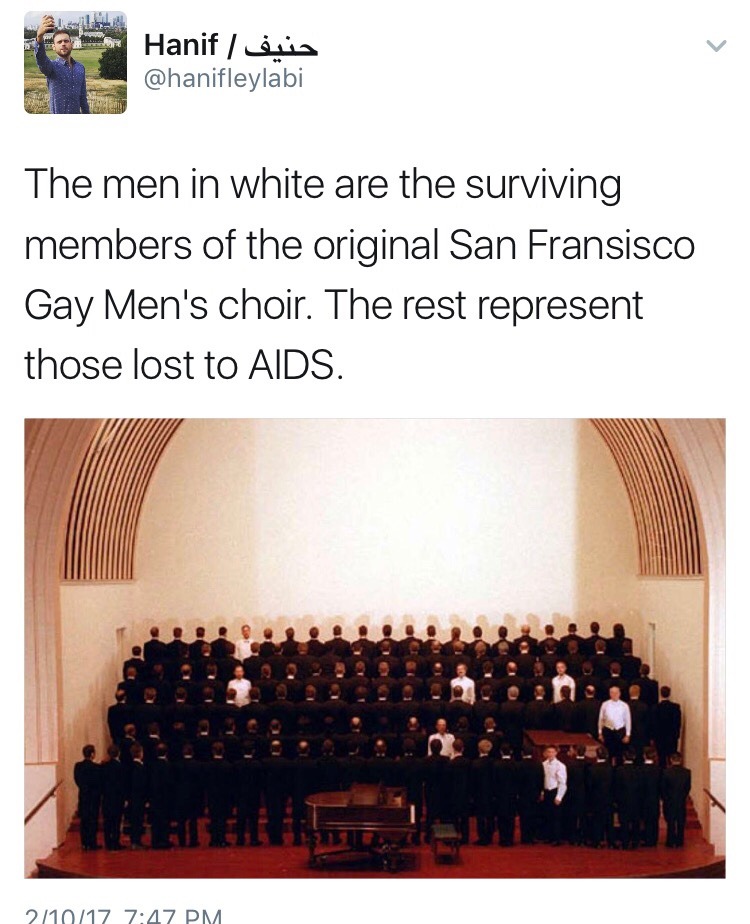
Look at this, and remember it next time someone says that the gay community survived the AIDS epidemic.
We didn’t survive, we started over. We lost all but an entire generation.
This is what “we survived Reagan, you’ll survive Trump” looks like. No, we didn’t.
^^^ I hate that line. Because a great many people didn’t survive Reagan, and a good many more won’t survive Trump. People who say that clearly haven’t gotten a goddamned clue.
people seem to have trouble understanding why i’m an anti-capitalist, so i’m going to try and put it into simple, real-life terms.
i work at a restaurant. i make $12 an hour, plus tips. minimum wage where i live is relatively high for my country – the national minimum wage is $7.25/hr, and has not been raised since 2009. before taxes, working full time, my yearly income is about $22,000 a year. ($25,000 if you count tips)
at my job, we sell various dishes, with an average price of about $10-$15. we get printouts every week detailing how much money we made that week; in one week, our restaurant makes about $30,000. (one of our other locations actually makes this much on a daily basis!)
i’m not going to go into details, but after the costs of production
(payroll for employees, rent for the building, maintenance, and wholesale food purchasing) are accounted for, the restaurant makes an estimated profit of $20,000 per week.
this profit goes directly to the owner, who does not work at this location. the owner of my restaurant has actually been on vacation for a few months, but still profits from the restaurant, because they own it. i have met the owner exactly twice in my year of working here.
to put this into perspective, the owner of this restaurant earns in 2 days what they pay me in one year. and that’s just from this single location – the owner has several other restaurants, all of which make more money than the one i work at. this ends up resulting in the owner having an estimated net worth of tens of millions of dollars, even after accounting for the payroll for every single worker in their employ.
now, i have to ask you: does the owner of my restaurant deserve this income? did they earn it? did their labor result in this value being created?
the naive answer would be “yes”; the owner purchased the location and arranged for the raw ingredients to be delivered, did they not?
the actual answer is “no”. the owner may have used their initial capital to start the location, but the profit is a result of my labor, and the labor of my co-workers.
the owner purchases rice at a very low bulk price of about 25 cents a pound. i cook the rice, and within a few minutes, that pound of rice is suddenly worth about $30. the owner did not create this value, i did. the owner simply provided the initial capital investment required to start the process.
what needs to be understood here is that capitalists do not create value. they use the labor of their employees to create value, and then take the excess profit and keep it.
what needs to be understood is that capitalists accrue income by already HAVING money. the owner of my restaurant was only able to get this far because they started off, from the very beginning, with enough money to purchase a building, purchase food in bulk, and hire hundreds of employees.
that is to say: the rich get richer, and they do so by exploiting the labor of the poor.
the owner of my restaurant could afford to triple the income of every single person in their employee if they felt like it, but this would mean that they were generating less profit for themselves, so they do not.
the owner of my restaurant pays me the current minimum wage of my area, because to them, i am not a person. i am an investment. i am an asset. i am a means to create more money.
when you are paid minimum wage, the message your boss is sending you is this: “legally, if i could pay you less, i would.”
every capitalist on the planet exploits their workers for their own gain. every capitalist, even the small business owners, forces people to stay in poverty so that the capitalist can profit.
me: ok edgelord we get it what if i slit my wrists right now can we please just focus
Additionally; me: *waiting for the subway* intrusive thoughts: what if you jumped me: it would cause a four hour delay while they pick your body parts out of the rails you fucking prick, can we please for once get on public transit without going through this
Also; Me: *walking along a busy road* intrusive thoughts: What if you just fell over in front of this truck? Me: It would back up traffic all fucking night and probably hurt a lot of people you prick.
Gosh. I never have thoughts like this
didnt ask but that sounds nice
Me: *walking down the stairs* Intrusive Thought: I could throw myself down these flight of stairs and leave more time for everyone else! Me: Or you end up with a broken wrist and sprain ankle you dickhead keep walking
Me: *driving on a bridge* Intrusive thoughts: I could just drive straight into that lake and finish it right now. Me: You asshole, this is a new car. Just fucking keep going like everyone else you prick.
oh my god,^^^^^^^^^^^^^^^^^^^^^^^^^^^^^^
I needed this
Me: *standing at a lookout* It’s so beautiful here…
Intrusive thoughts: yeah, look at that view, you could just step out into it and you’d probably never feel the impact when you hit the ground 20m below…
Me: Bitch, don’t ruin the view for everyone else. Fucksake.
Me: *doing literally nothing*
Intrusive thoughts: What if-
Me: Can’t you just shut the fuck up and chill for once? God damn



























 May's Blog